 Pearl Harbor Tours from Honolulu
The Attack on Pearl Harbor
The attack on Pearl Harbor on the morning of December 7, 1941 brought the United States into World War II. Japanese aircraft struck the Pacific Fleet at its base on Oahu just before 8 a.m., sinking battleships and killing 2,403 Americans by the standard count. This page explains why Japan attacked, how the morning unfolded, what was lost and what you can still see at Pearl Harbor today. If you are planning a visit, the comparison of Pearl Harbor tours from Honolulu covers every tour side by side, from a half day at the USS Arizona Memorial to a full day across all four sites.
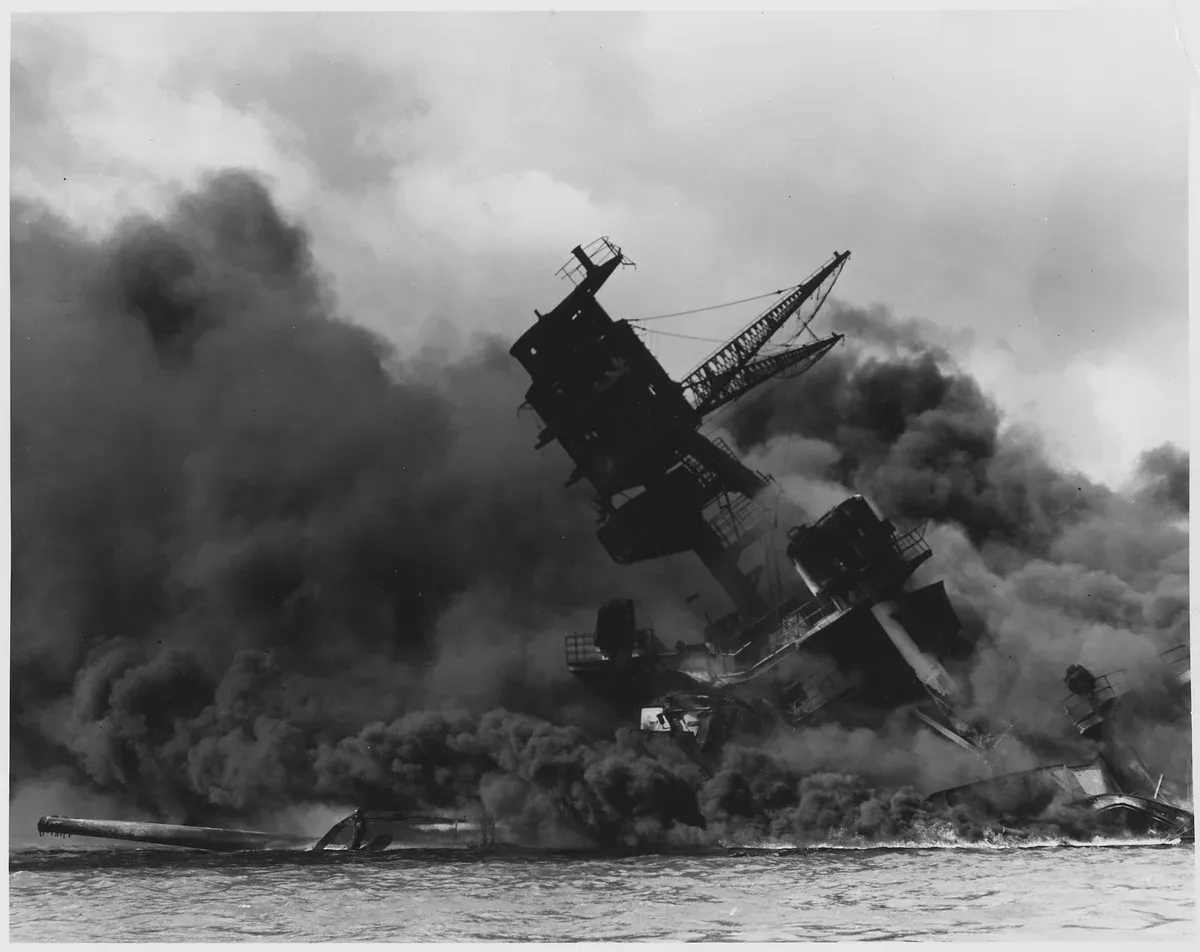
The USS Arizona burning after the Japanese attack. Photo: Unknown author Unknown author or not provided, Public domain, via Wikimedia Commons
Quick answer The attack in brief
The attack on Pearl Harbor began on the morning of December 7, 1941, when 353 Japanese aircraft in two waves from six carriers struck the US Pacific Fleet just before 8 a.m. Hawaii time. The carriers launched from about 230 miles north of Oahu. All eight US battleships present were damaged, four were sunk, and more than 180 US aircraft were destroyed. 2,403 Americans were killed and 1,178 wounded.
Key takeaways
- The Arizona lost 1,177 officers and crewmen when a bomb set off her forward magazine. See what a visit covers in the USS Arizona Memorial guide.
- Japan surrendered on the deck of the Battleship Missouri on September 2, 1945, and the ship now sits at Pearl Harbor.
- Jump to the minute-by-minute account of the morning or the full list of what was lost.
- To see the harbor where it happened, the Pearl Harbor USS Arizona Memorial Tour runs 4 hours from Waikiki for $51 per person.
December 7, 1941
The attack came from the north, from six carriers about 230 miles from Oahu, and it brought the United States into the war.
How the Morning Unfolded
Admiral Yamamoto planned the attack as a pre-emptive strike on the Pacific Fleet, which had been based at Pearl Harbor since 1940. The strike force included 353 fighters, level and dive bombers and torpedo bombers, flying from six aircraft carriers positioned about 230 miles north of Oahu. The first bombs fell just before 8 a.m. Hawaii time on a Sunday morning. The National Park Service marks 7:55 a.m. with a moment of silence at its remembrance ceremony.
The phases below follow the two waves and the immediate aftermath. Japan declared war on the United States and the British Empire later that day, though the declarations were delivered the next day. The US declared war on Japan the following day, and President Roosevelt called December 7, 1941 "a date which will live in infamy".
| Time or phase | What happened |
|---|---|
| Just before 8 a.m. | The first wave of Japanese aircraft reaches Pearl Harbor and the attack begins on a Sunday morning. |
| The first wave | Torpedo and dive bombers strike the ships along Battleship Row and the airfields at the same time. |
| The second wave | A second wave of aircraft follows from the same six carriers, extending the damage to ships and air bases. |
| December 8, 1941 | The United States declares war on Japan, with Roosevelt's "date which will live in infamy" speech. |
| September 2, 1945 | Japan signs the Instrument of Surrender on the quarterdeck of the USS Missouri, ending World War II. |
Why Japan Attacked
Admiral Yamamoto planned the attack as a pre-emptive strike on the US Pacific Fleet, which had been based at Pearl Harbor since 1940. Japan declared war on the United States and the British Empire on the day of the attack, with the formal declarations delivered the next day.
The strategic result was the opposite of a knockout blow. The three US aircraft carriers based at Pearl Harbor were at sea that morning and escaped untouched, and the attack brought the United States into World War II the very next day. In 1945 the war ended aboard the Missouri in Tokyo Bay, a ship you can still board on the Best of Pearl Harbor Full-Day Tour, a 10-hour day covering four sites for $208 per person.
Battleship Row and the Two Waves
The ships moored along Battleship Row took the heaviest damage. Of the eight US battleships present, all eight were damaged and four were sunk. The USS Arizona exploded when a bomb detonated her forward magazine, an explosion that accounted for nearly half of all American fatalities that morning. The USS Oklahoma capsized and the USS Utah, a former battleship converted to a target ship, also rolled over and sank.
The airfields were hit in the same minutes. More than 180 US aircraft were destroyed. The hangars at what is now the Pearl Harbor Aviation Museum still carry damage from that morning, and the museum holds more than 50 aircraft in those original hangars on Ford Island. Visitors without base access reach the island on a shuttle or on the Arizona and Battleship Missouri Tour, a 6-hour day from Waikiki at $156 per person.
What Was Lost
The human cost fell heaviest on the battleships along Battleship Row. The figures below come from the standard historical account, with the ship-by-ship detail where sources state it.
Ships, Airfields and the Dead
2,403 Americans were killed and 1,178 wounded in the attack, the standard count attributed to the historical record. The dead were 2,008 sailors, 218 soldiers and airmen, 109 Marines and 68 civilians. The National Park Service has referred to "2,390 American lives lost" in its anniversary material, so the total appears slightly differently across sources. The 2,403 figure is the most widely cited.
The table lists where the losses happened and the killed figures stated for each. Where a source gives no separate count for a ship or place, none is printed.
| Ship or place | What happened | Killed (where stated) |
|---|---|---|
| USS Arizona | A bomb detonated her forward magazine and the ship exploded and burned. Nearly half of all American fatalities that morning came from this single explosion. | 1,177 officers and crewmen |
| USS Oklahoma | Capsized in the attack. | not stated |
| USS Utah | A former battleship converted to a target ship, sunk at its berth. | not stated |
| Battleship Row | All eight US battleships present were damaged and four were sunk. | included in the totals above |
| Hickam Field and the air bases | More than 180 US aircraft were destroyed. | not stated |
| Pearl Harbor total | The attack damaged or destroyed much of the Pacific Fleet's battle line. | 2,403 Americans killed, 1,178 wounded |
The Arizona's Crew
The Arizona's loss of 1,177 officers and crewmen accounts for nearly half of all American deaths in the attack. The remains of many of the crew are still inside the hull, which rests in the mud of Pearl Harbor where she sank. Surviving crewmen may still choose to be interred in the wreck, and 334 crewmen survived the explosion. Urns of survivors have been placed in the well of Barbette No. 4.
The wall of the memorial's Shrine Room, cut from Vermont marble, carries the names of all 1,177 dead. Oil still leaks from the hull a drop at a time, which the National Park Service calls "considered the tears of the fallen". The NPS estimates about half a million gallons of oil remain inside the stern and monitors the wreck constantly. How to visit the ship and the memorial above it is covered in the USS Arizona Memorial guide.
Aftermath: From Infamy to Surrender
The United States declared war on Japan on December 8, 1941, the day after the attack. The war in the Pacific ran nearly four more years and ended on September 2, 1945. On that day, the Japanese Instrument of Surrender was signed on the quarterdeck of the USS Missouri in Tokyo Bay, formally ending World War II. MacArthur boarded at 08:43, the Japanese delegation led by Mamoru Shigemitsu arrived at 08:56, and by 09:30 the Japanese emissaries had departed.
The Missouri and the Arizona are often described as bookending the war. The battleship where it ended now rests on Ford Island in Pearl Harbor, near the Arizona, as the Battleship Missouri Memorial, a museum ship since 1998. Many visitors see both in one day. The Small-Group Arizona and Missouri Tour runs 6 hours from Waikiki for $157 per person, capped at 25 guests, and lists the Arizona Memorial (depending on availability), the Missouri and a drive past Punchbowl and the King Kamehameha Statue.
The Attack on Pearl Harbor
A museum lecture on how the attack was planned and flown. Third-party video by Smithsonian National Air and Space Museum. This site did not shoot it and has no relationship with the creator.
Why Japan Attacked
Japan's decision, in outline, was a pre-emptive strike on the Pacific Fleet at Pearl Harbor.
A Pre-emptive Strike on the Pacific Fleet
Admiral Isoroku Yamamoto planned the attack as a pre-emptive strike on the United States Pacific Fleet, which had been based at Pearl Harbor since 1940. The aim was to hit the fleet at anchor before it could fight. Japan declared war on the United States and the British Empire later that day, but the declarations were delivered the next day.
The strike force was built around six aircraft carriers about 230 miles north of Oahu. From them came 353 fighters, level and dive bombers and torpedo bombers, in two waves. Their targets were the battleships lined up along Battleship Row, the airfields and the hangars around the harbor. On the air side, the attack succeeded. More than 180 US aircraft were destroyed, and the hangars of what is now the Pearl Harbor Aviation Museum still carry the damage from that morning.
On its central aim the plan failed. The three US carriers based at Pearl Harbor were at sea and escaped untouched, and the attack missed them. Of the eight US battleships present, all were damaged and four were sunk. The attack drew the United States into the war the next day, when President Roosevelt called December 7, 1941 "a date which will live in infamy" and the United States declared war on Japan.
What the Plan Aimed For and What Followed
The attack was a pre-emptive strike on a fleet based at Pearl Harbor since 1940, planned by Yamamoto. What the record shows is the gap between what Japan hoped to achieve and what followed. A strike meant to keep the Pacific Fleet out of the war's opening moves instead produced a declaration of war within a day.
The three carriers based at Pearl Harbor were at sea and escaped. Visitors who want the airfield side of the story can see it at the Pearl Harbor Aviation Museum, which sits in the original hangars attacked on December 7 and holds more than 50 aircraft from the war that followed.
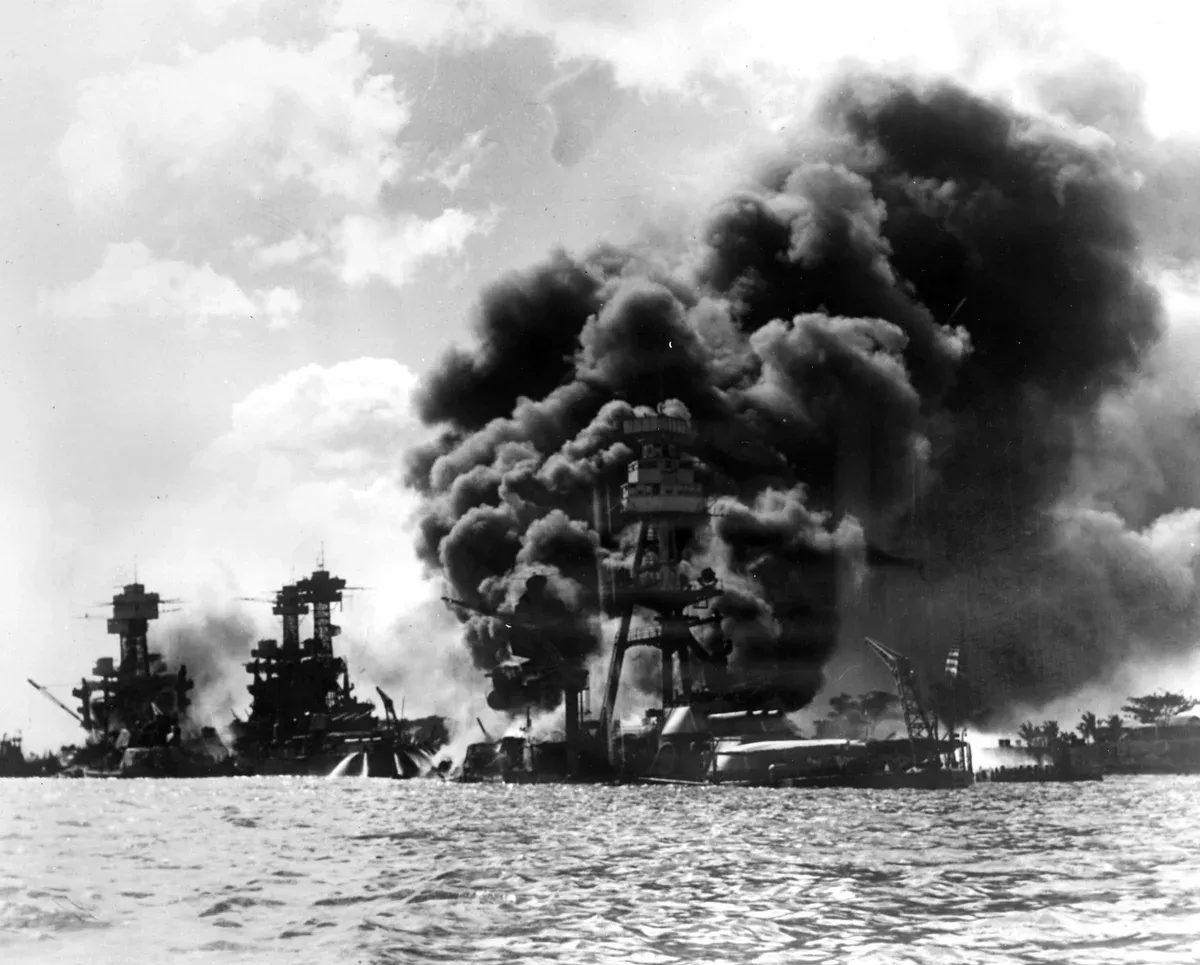
Official US Navy photograph looking up Battleship Row during the attack, with the Arizona burning. Photo: Official U.S. Navy photograph NH 97378 ., Public domain, via Wikimedia Commons
From the Attack to the Surrender
The war that began at Pearl Harbor on December 7, 1941 ended on the deck of a battleship in Tokyo Bay less than four years later. The two ships at the center of that span still sit in the same harbor.
The War the Attack Started
The attack on Pearl Harbor brought the United States into World War II on December 8, 1941. The three carriers based at Pearl Harbor were at sea and escaped. The cost of the opening morning: 2,403 Americans killed and 1,178 wounded, by the standard count. On the Arizona alone, 1,177 officers and crewmen died when a bomb set off her forward magazine, and nearly half of all the American fatalities that morning came from that single explosion.
In Hawaii the aftermath is visible at Punchbowl Cemetery, the National Memorial Cemetery of the Pacific, where about 53,000 WWII, Korean and Vietnam War veterans and dependents are interred. The Courts of the Missing there list 18,095 Americans missing from the Pacific in World War II. Chief Boatswain Edwin Hill, killed on the USS Nevada on December 7, 1941, is buried at Punchbowl.
September 2, 1945 on the Missouri
The Japanese Instrument of Surrender was signed on the quarterdeck of the USS Missouri on September 2, 1945, ending World War II. The timetable of that morning is recorded. General MacArthur boarded at 08:43. The Japanese delegation, led by Mamoru Shigemitsu, arrived at 08:56. By 09:30 the Japanese emissaries had departed, and the war that began with the attack on Pearl Harbor was over.
The Missouri herself was new to the war's end. She had been launched on January 29, 1944 at the Brooklyn Navy Yard before a crowd of 20,000 to 30,000. Today she is a museum ship on Ford Island, donated to the USS Missouri Memorial Association in 1998, and the association says she has drawn more than 10 million visitors. She is 887 feet long, and her teak deck covers 53,000 square feet. The Missouri and the Arizona now bookend World War II in one harbor, the battleship where the United States was pushed into the war and the battleship where the war was signed to a close. You can visit both on the Arizona and Battleship Missouri Tour, a 6 hour day from Waikiki at $156 per person.
Where to See It Today
Every part of the attack described on this page has a place you can stand in or a ship you can walk. Here is what each site holds and which tours cover it.
The USS Arizona Memorial
The white memorial spans the mid-portion of the sunken battleship, 184 feet long, with an entry room, an assembly room and a shrine room. The shrine room wall of Vermont marble carries the names of the Arizona's 1,177 dead. Through the openings you can see the hull eight feet below, and oil still leaks from the wreck a drop at a time. The NPS calls those droplets the tears of the fallen. The NPS says the ship is the final resting place of many of the 1,177 crewmen who died, and surviving crewmen can still be interred there. The US flag flies from a pole attached to her severed mainmast.
The program is free but reserved only through Recreation.gov, with a $1 fee per ticket. Boats run every 15 minutes from 8 am to 12 noon and 1 pm to 3:30 pm, each carrying 145 people, and the NPS says the whole program lasts about 45 minutes with 10 to 15 minutes on the memorial itself. The full detail, including the reservation windows and the standby line, is in the guide to the USS Arizona Memorial. Half-day Pearl Harbor tours from Honolulu such as the Small-Group Arizona Memorial Tour, 4 hours at $100 per person, include the boat ride, though no tour can guarantee a landing when the Navy suspends operations.
The Utah, the Oklahoma and Ford Island
Pearl Harbor National Memorial also includes the USS Utah and USS Oklahoma memorials, six chief petty officer bungalows and the Battleship Row quays. The Utah, a former target ship, was lost that morning. Both memorials sit on Ford Island, an active military area.
Visitors without military base access can reach them on the NPS Ford Island Bus Tour, which the NPS notes does not include the Arizona Memorial and can clash with the 2:30 pm, 3:00 pm and 3:30 pm Arizona boat programs. The Ford Island guide covers access rules in detail.
The Battleship Missouri
The Missouri is where the war ended. She opened as a museum ship in 1998 and now offers guided tours in English, Japanese, Korean and Chinese. An elevator runs from the Main Deck to the Surrender Deck, though the lower decks, the flying bridge and most interiors are not wheelchair accessible.
The Missouri advises a half-day plan of the Arizona plus the Missouri when time is short, and says most visitors spend 1 to 2 hours aboard. Admission is not sold directly here because the Missouri is sold inside the tours, including the Small-Group Arizona and Missouri Tour at $157 per person over 6 hours. The full visit guide is at Battleship Missouri.
The Aviation Museum Hangars
The Pearl Harbor Aviation Museum occupies Hangar 37 and Hangar 79 on Ford Island, the original hangars attacked on December 7, and it opened on December 7, 2006. The hangars still show damage from the attack. General admission covers more than 50 aircraft, both hangars, the outdoor exhibits and the Operations Building rooftop terrace.
It fits into the full-day routes, including the Best of Pearl Harbor Full-Day Tour, 10 hours at $208 per person with all four sites, and the Pearl Harbor Heroes Deluxe Tour, 9.5 hours at $214 per person. The USS Bowfin Submarine Museum sits next to the visitor center, where the Bowfin, launched on December 7, 1942, exactly one year after the attack, has been open to tours since 1981.
Choosing a Tour That Covers the Story
The table below compares the tours in the catalog that cover the sites tied to the attack and its aftermath, with prices, durations and sites as listed by each operator on its listing page.
| Tour | Price | Duration | Sites covered |
|---|---|---|---|
| Salute to Pearl Harbor Tour | $59 | 5 hours | Visitor center, Arizona Memorial shuttle, downtown drive-by |
| Pearl Harbor, USS Arizona Memorial & Honolulu Deluxe Coach Tour | $59.23 | 5 hours, with 8 and 9-hour options | Arizona Memorial, city sights, Missouri and Aviation Museum on upgrades |
| Arizona and Battleship Missouri Tour | $156 | 6 hours | Arizona Memorial, USS Missouri |
| Small-Group Arizona and Missouri Tour | $157 | 6 hours | Arizona Memorial, USS Missouri |
| Best of Pearl Harbor Full-Day Tour | $208 | 10 hours | Arizona Memorial, USS Bowfin, USS Missouri, Aviation Museum |
| Pearl Harbor Heroes Deluxe Tour | $214 | 9.5 hours | Arizona Memorial, USS Missouri, USS Bowfin, Aviation Museum, lunch included |
Sources: National Park Service and Pearl Harbor Historic Sites
Questions About the Attack on Pearl Harbor
Why did Japan attack Pearl Harbor?
The recorded reason is that Admiral Yamamoto planned the attack as a pre-emptive strike on the United States Pacific Fleet, based at Pearl Harbor since 1940. The strike failed in its central aim because the three US carriers were at sea and escaped. The background and the morning are covered in the sections above, and the sites you can visit are introduced in the guide to Pearl Harbor tours from Honolulu.
How many aircraft did Japan send against Pearl Harbor?
353 fighters, level and dive bombers and torpedo bombers attacked in two waves, launched from six aircraft carriers about 230 miles north of Oahu. You can stand in the hangars attacked on December 7 at the Pearl Harbor Aviation Museum, which keeps the battle damage on display.
How many Americans died in the attack on Pearl Harbor?
The standard count is 2,403 Americans killed and 1,178 wounded, an NPS release for the 80th anniversary gives 2,390 lost, so sources differ slightly. The dead included 2,008 sailors, 218 soldiers and airmen, 109 Marines and 68 civilians. Nearly half the fatalities came from the explosion of the Arizona's forward magazine.
Did Japan warn the United States before the attack?
Japan declared war on the United States and the British Empire later that day, but the declarations were delivered the next day, after the strike. The visitor-side consequences, from reservations to the Pearl Harbor bag policy, are covered in the planning guides.
Where did World War II formally end after the attack on Pearl Harbor?
On the quarterdeck of the USS Missouri in Tokyo Bay, where the Japanese Instrument of Surrender was signed on September 2, 1945. MacArthur boarded at 08:43, the Japanese delegation led by Mamoru Shigemitsu arrived at 08:56, and the emissaries had departed by 09:30. The Missouri is now a museum ship on Ford Island, described in the guide to the Battleship Missouri.
Can you see the ships hit in the attack today?
Yes. The Arizona lies under the USS Arizona Memorial, the Utah and Oklahoma memorials stand on Ford Island and are reached on the NPS Ford Island Bus Tour, and the Missouri is moored on Ford Island. The hangars of the Pearl Harbor Aviation Museum still show damage from the December 7 attack. Tours covering all four sites, such as the Best of Pearl Harbor Full-Day Tour, run 10 hours at $208 per person.